Apopka Backflow Testing Requirements
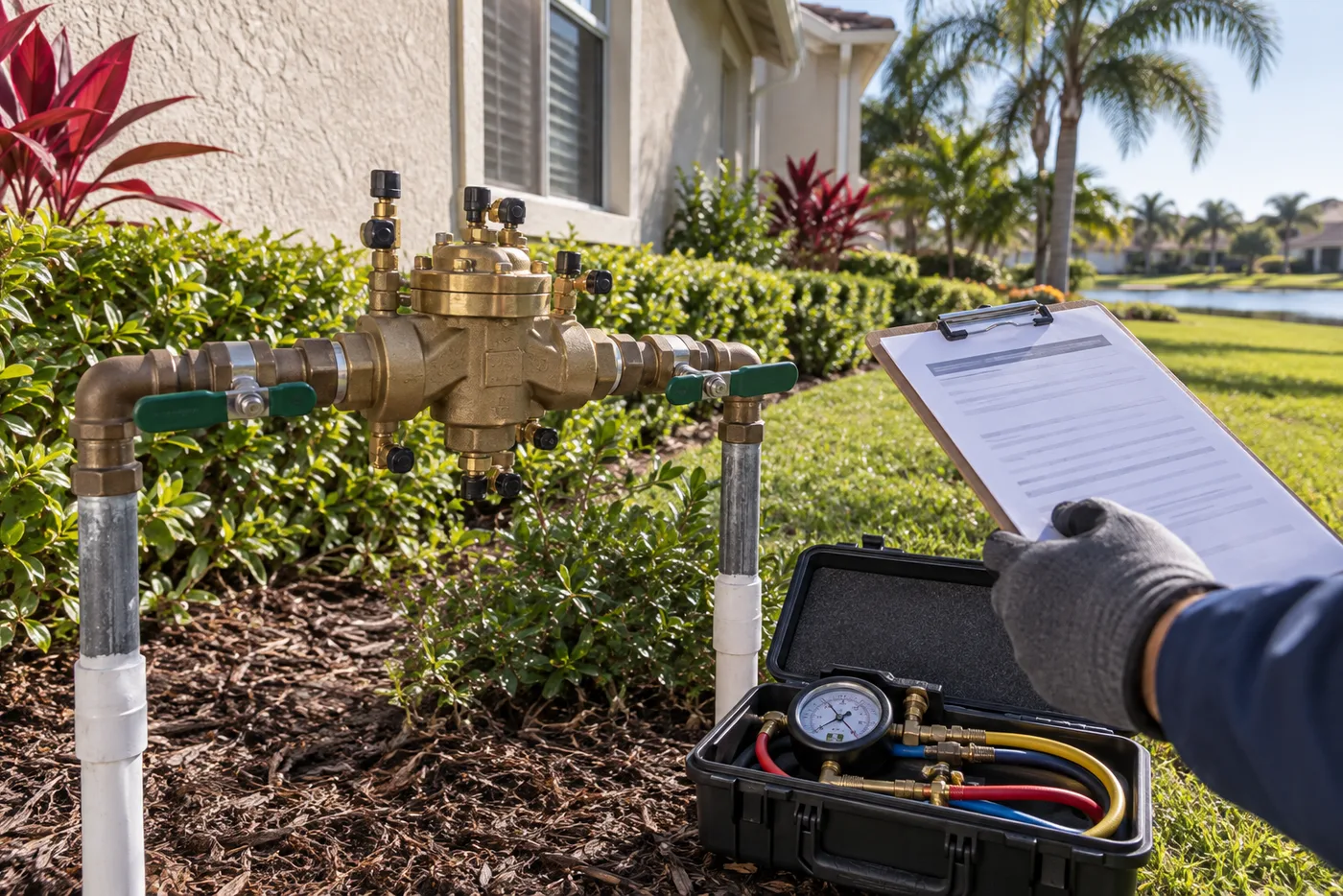
The City of Apopka requires periodic testing for covered backflow prevention assemblies. Residential and commercial schedules differ, reclaimed-water dual checks follow a separate maintenance process, and a failed assembly must be corrected and tested again.
First confirm that the property is served by the City of Apopka. A mailing address can fall within a different utility’s service area, and each utility controls its own testing, reporting, and approved-tester process.
Apopka requirements at a glance
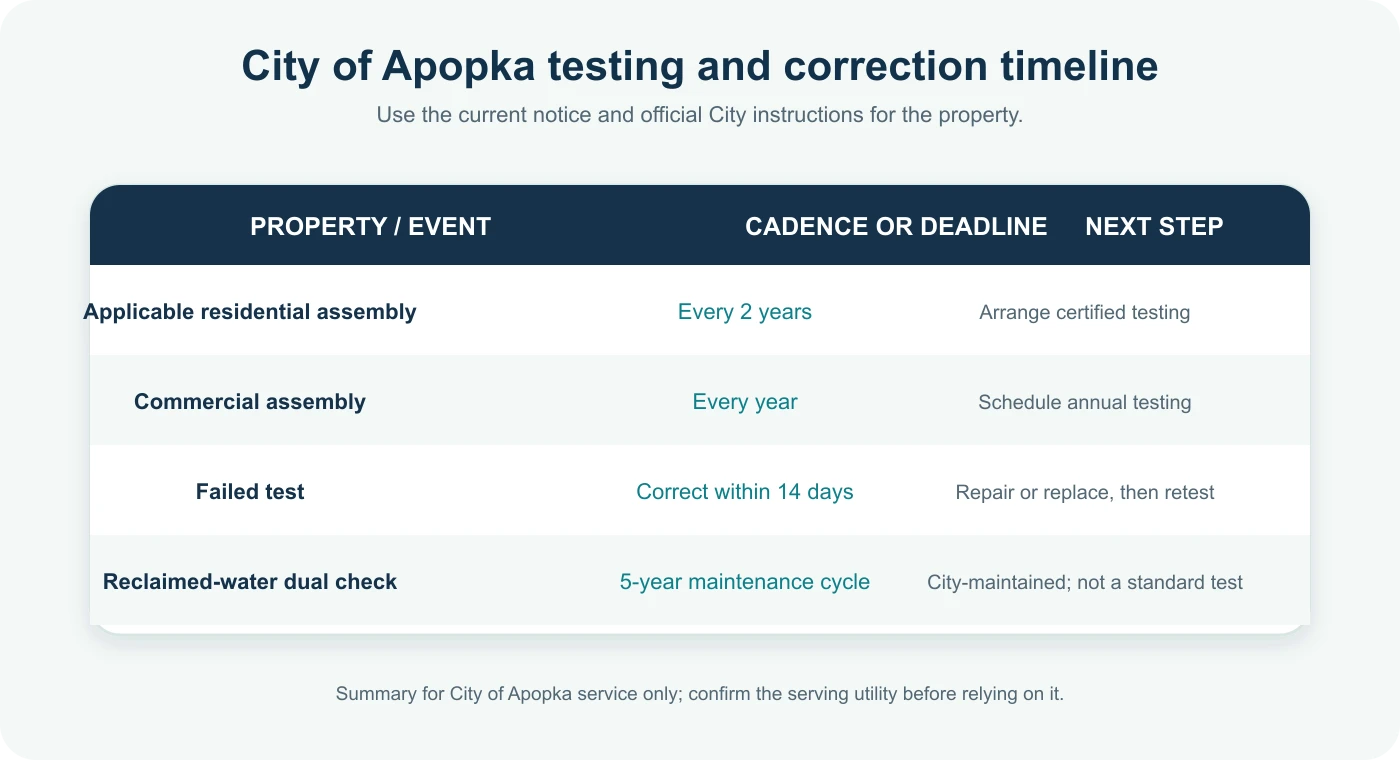
| Property or device | City requirement | Important detail |
|---|---|---|
| Applicable residential assembly | Test every two years | Testing is mandatory for covered assemblies. |
| Commercial assembly | Test annually | Failed commercial tests require immediate remediation. |
| Reclaimed-water dual check | Maintenance every five years | The City says these devices are not testable like standard assemblies. |
| Failed test | Repair and retest, or replace, within 14 days | Follow any earlier due date or special instruction on the notice. |
| After installation or repair | Inspection or testing required | The acceptable result must be documented and reported. |
Residential testing every two years
The City’s published testing page states that residential testing is required every two years. The ordinance describes inspections after installation or repair and at least every two years thereafter for residential service connections. This schedule applies to testable assemblies covered by the City program, not automatically to every device at every Apopka mailing address.
Residential cross-connection risks can involve potable-water irrigation, reclaimed or auxiliary water, pools, outside hose connections, and some fire-sprinkler arrangements. The required protection depends on the hazard and the City’s evaluation. For homeowner-specific preparation, visit Residential Backflow Testing or Irrigation Backflow Testing.
Commercial testing every year
Commercial properties covered by the program are required to test annually. A site can have more than one assembly, so the notice, site records, and assembly inventory should be reviewed before service. The City’s current guidance says failed commercial tests must be remediated immediately. Learn more on the Commercial Backflow Testing page.
Reclaimed-water dual checks are different
The City distinguishes reclaimed-water dual check devices from standard testable assemblies. Its published guidance says a dual check is maintained every five years because it is not testable. Do not assume a notice for a dual check requires the same field test or reporting process as a reduced-pressure, double-check, or pressure-vacuum-breaker assembly.
Who may test and how results are reported
The City accepts properly certified professionals who can supply proof of current acceptable certification. Its tester list is offered as a courtesy; the City expressly says the listed technicians are not affiliated with it. Certified testers enroll with the City and submit test results through the Backflow BMP portal.
- The property owner or manager provides the notice and assembly details.
- The tester confirms credentials, access, and the correct assembly.
- Calibrated test equipment is used to record component performance.
- If the assembly passes, the tester completes the applicable City reporting process.
- If it fails, the assembly is repaired and retested or replaced and tested before a passing result is reported.
What happens after a failed test?
Section 78-211 of the Apopka Code requires a failed device to be repaired and retested, or replaced, within 14 days if it does not meet performance standards. The City’s testing page separately states that commercial failures need immediate remediation. Because the notice may set a property-specific due date or identify a higher-risk condition, follow the most urgent applicable instruction.
Testing alone does not correct a failure. Review What to Do After a Failed Backflow Test, then compare Backflow Repair with Backflow Replacement. Any repair or new assembly must be tested to document acceptable performance.
Installation, permits, and fire protection
The City manual says backflow assemblies may be installed only by appropriately authorized parties and must be tested at installation or repair. It expressly requires a City plumbing permit for new construction and fire-protection devices. Fire-line work can also fall under separate Florida fire-protection licensing rules, so use a properly qualified provider for the scope. See Fire-Line Backflow Testing.
What to do after receiving an Apopka notice
- Keep the notice and use its due date.
- Confirm the City of Apopka is the serving utility.
- Locate the assembly without operating its valves.
- Photograph the device tag, manufacturer, model, size, and serial number if accessible.
- Arrange service with a properly certified tester.
- Ask who will submit the result through the required portal.
- Keep the completed test, repair, and submission records.
Official Apopka sources
- City of Apopka Testing Requirements
- City of Apopka Cross-Connection Program
- City of Apopka Utilities Cross-Connection Control Manual
- Apopka Code of Ordinances, Article V
This independent guide summarizes published sources and is not a City notice or legal interpretation. Current City instructions and the notice for the property control.