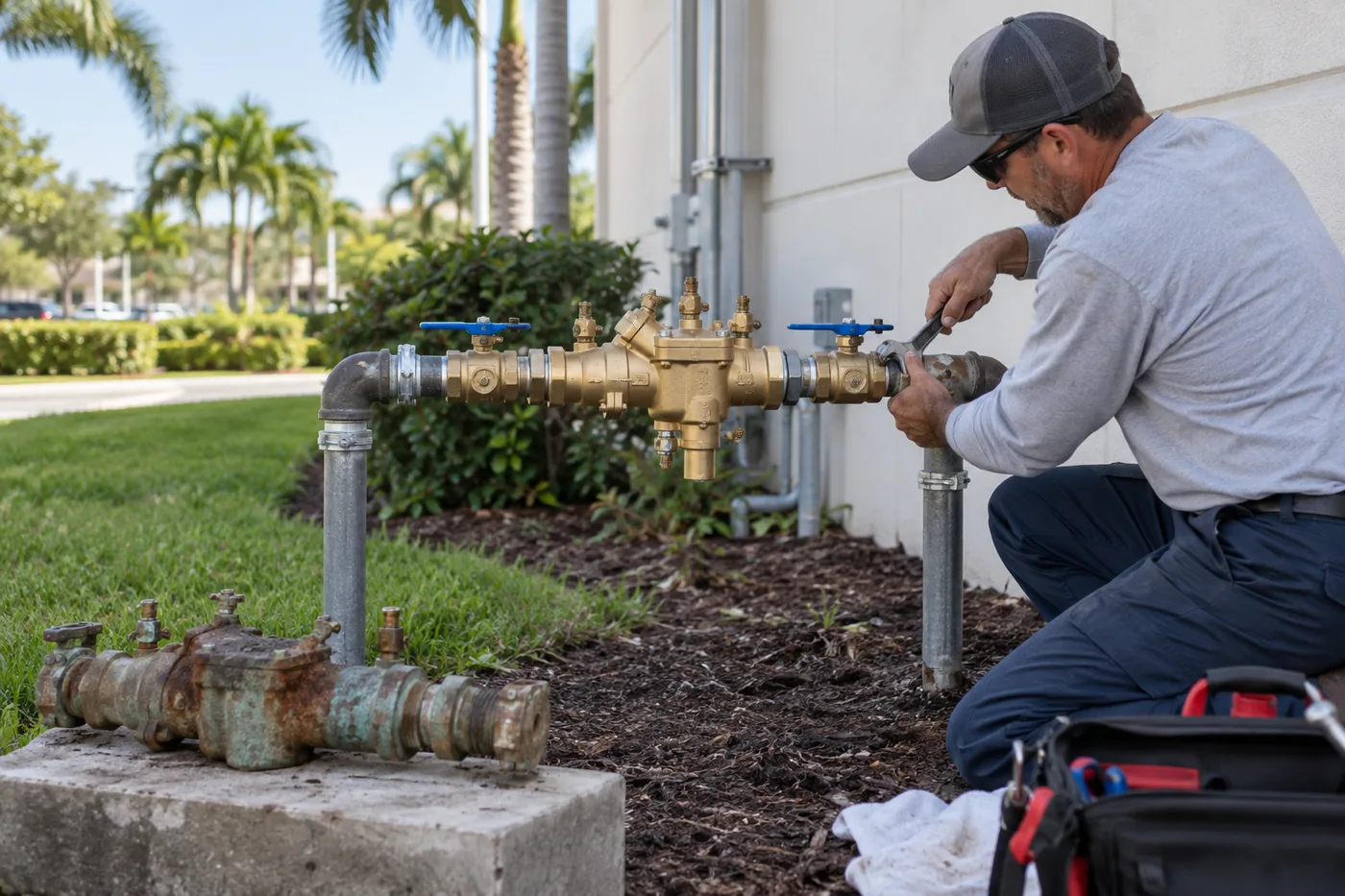
Replacement becomes the stronger option when a backflow assembly is cracked, obsolete, incorrectly configured, repeatedly failing, or uneconomical to rebuild. Choosing a replacement is not simply a matter of matching the pipe size. The assembly type must provide the protection required for the water source, hazard, property use, and serving utility.
For City of Apopka accounts, the water customer is responsible for required installation, testing, maintenance, and corrective work. The City does not currently replace devices that require certified work. A qualified provider should confirm the approved assembly and installation requirements before removing the existing device.
Reasons an assembly may need replacement
- Freeze damage, a cracked valve body, severe corrosion, or impact damage
- Approved internal parts are unavailable or the model is obsolete
- The assembly has repeated failures or chronic relief-valve discharge
- The existing type does not match the current hazard or City requirement
- The installation is inaccessible, incorrectly oriented, or lacks necessary clearance
- Shutoff valves, body, and internal components would all require substantial work
- Expected repair cost approaches the cost of a properly installed approved replacement
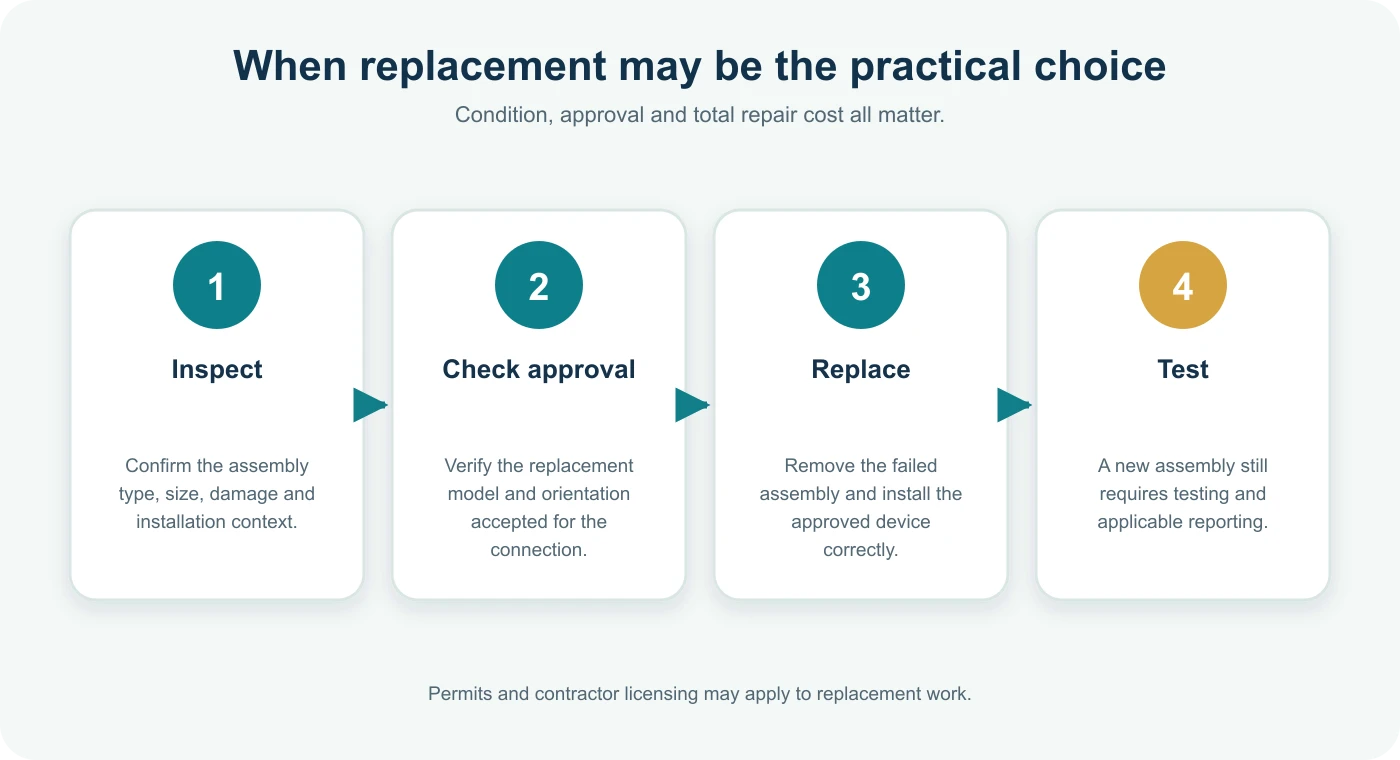
Plan before replacing a backflow preventer
- Confirm the serving utility. Requirements and reporting differ among Central Florida utilities.
- Identify the service and hazard. Domestic, irrigation, well, pond, reclaimed-water, process, and fire-line connections are not interchangeable.
- Document the existing assembly. Record the type, make, model, size, serial number, orientation, location, and failed result.
- Verify the approved replacement. Type, make, model, size, lead-content compliance, enclosure, drainage, and clearances may matter.
- Confirm permits and qualifications. The answer depends on whether the work is a direct replacement, piping alteration, new construction, or fire-protection scope.
- Test and report the new assembly. Installation is followed by testing and the applicable utility submission process.
Approved assemblies and installation details
Apopka’s manual says testable backflow prevention assemblies must be approved by the University of Southern California Foundation for Cross-Connection Control and Hydraulic Research, while dual checks must have the stated ASSE approval. Mechanical devices must also meet applicable federal lead-content standards.
The manual generally places the assembly immediately downstream of the water meter without branches or tees before it, unless the City approves an alternate location. Installation must follow the manufacturer’s specifications and the City’s current requirements. A photo alone is not enough to select the replacement.
Repair or replace?
Repair can be reasonable when the body, shutoff valves, and installation are sound and approved parts are available. Replacement may reduce repeated corrective work when the assembly is badly deteriorated, obsolete, or unsuitable for the identified hazard. Ask for an explanation based on the failed measurement and device condition.
Testing, deadlines, and reporting
A newly installed replacement must be tested as required. If replacement follows a failed test, Apopka’s ordinance sets a 14-day correction period, while commercial failures require immediate remediation. The current notice may impose the more urgent deadline.
The passing result must reach the City through its current approved process. Keep the failed report, replacement documentation, model and serial information, and passing test together. Review the failed-test guide and testing process.
Replacement questions
Does a new backflow preventer need to be tested?
Yes when required by the applicable program. Apopka requires inspection or testing following installation, and the completed result must be submitted properly.
Can an assembly be replaced with a different type?
Do not assume so. The required protection depends on the connection and hazard. Confirm the City-approved type and current installation rules before work begins.
Is a plumbing permit required?
Apopka’s manual expressly requires a City plumbing permit for new construction and fire-protection devices. A replacement or piping change should be reviewed for its specific permit and trade-license requirements before work.
What information helps with a replacement request?
Provide the address, serving utility, full notice, assembly and surrounding-area photos, device type and size, model information, failed result, water source, and due date.
Is Apopka Backflow the installer?
No. It is an independent informational and service-request website. It does not claim that an assigned provider has been selected until qualifications and coverage are confirmed.
See the Apopka requirements guide, official City assembly information, and the City manual.